
The first electronic ignition (a cold cathode type) was tested in 1948 by Delco-Remy in the USA. Transistors only started becoming commonly available around 1954 and Joseph Lucas Ltd introduced a transistorised ignition in 1955, which was used on BRM and Coventry Climax Formula One engines in 1962. Pontiac and Studebaker introduced the first transistor ignition sets on production automobiles in 1963. The 1969 Kawasaki 500 Mach-III is slated as the first production motor cycle to use electronic ignition, then in 1971 the first pointless moped would go into production.
During the second half of the 1960s, the Motokov import/export company for Czechoslovak automotive products was assessing the market potential for a lightweight motorised cycle or moped, which, in some countries, might not need a driving licence. Motokov was clearly looking toward competition with machines like the VéloSoleX in France, and Snorfiets classified models in the Netherlands.
As sole exporter for Jawa motor cycles, Motokov ordered two prototypes for appraisal from the Strojárne factory in Považské Bystrica. The first prototype resembled the Solex with a forward mounted engine over the front wheel, but was liked by neither Považské Strojárne (PS) nor Motokov, so this option was rejected. The second type fared somewhat better, but was not felt to meet the demands of the significant market, and this prototype was also declined.
Motokov’s interest in this small bike project then declined on the premise that there might be an insufficient market, however the PS management did not agree with the Motokov marketing, so continued with its developments to produce a machine for the lucrative Dutch and German markets, whose legislations required bicycle-like designs with pedal gear and large wheels.
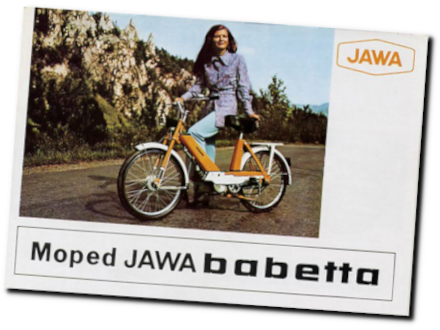
Two designers at PS—Safarík and Ulicky—were asked to come up with two new models, one with large 19" wheels, and the other with smaller 16" wheels. Since the export demand was initially focused toward the larger wheel version, the first moped prototype was produced in this format as a Type 28. An initial batch of 100 models was made in 1970 for testing and marketing appraisal and, in the spring of 1971, series production began. The bike was characterised by 19" wheels fitted with 23" tyres & a rigid rear frame, and it became the first moped with a contactless transistorised ignition system housed in a bright red box called Transimo 40 ignition. The ‘40’ reportedly related to the 40km/h specification the model was produced to (24.85mph).
At this time PS’s co-operation with Jawa had ended so a new model name other than Jawa was required, but PS didn’t want to revert to use of its old factory name of Manet, which they felt was too associated with scooters. About this time Jiří Suchý’s popular song Babeta šla do světa (Babetta went into the world), was airing in Czechoslovakia and the girl’s name Babeta (or Babetta) seemed well suited for the intention to produce a bike that should go out to world markets, so the Model-28 ‘Transistor 40’ became the first of the Babettas. The first Babetta-28 imports by Jawa–CZ (GB) Ltd of Estuary Road, Kings Lynn went on sale in the UK in June 1972. The motor specification was given as 39mm bore × 41mm stroke for 48.98cc, with 6.5:1 compression ratio, a 9mm Jikov carburettor, and rated at 1.5bhp @ 4,500rpm.
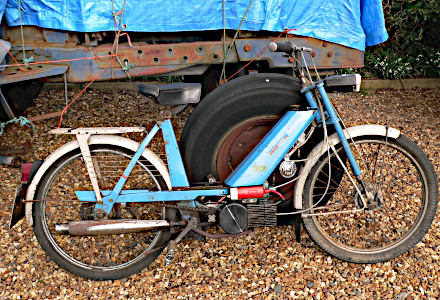
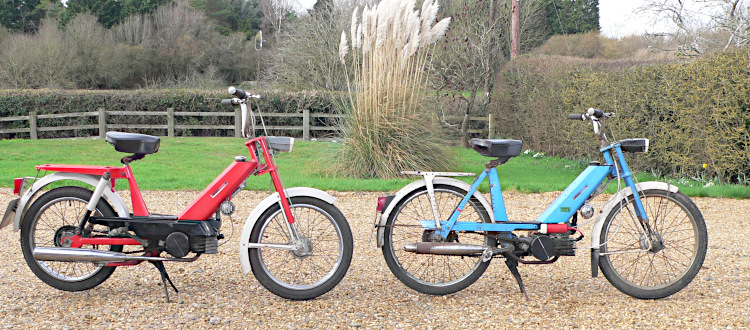
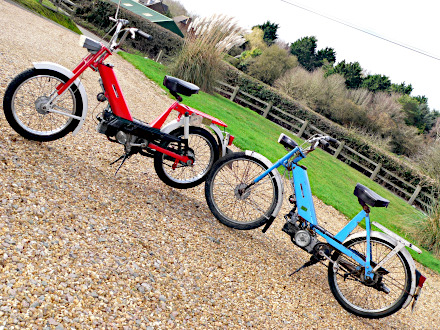
The frame plate on our particular blue test machine indicates it was made in 1972, though not ‘L’-registered until 1973, and sold by Mick Berrill Motorcycles of Henry Street, Northampton, who was reportedly encouraged to become an agent by his Czech wife.
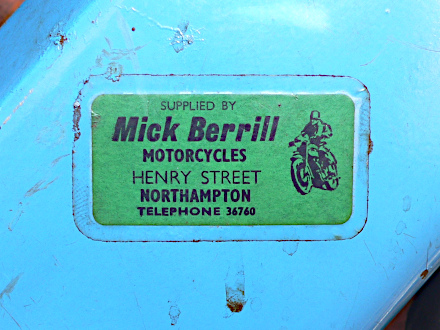
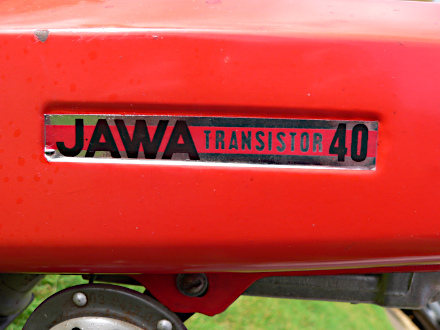
The tank decals are branded ‘Jawa Transistor 40’ with no apparent reference to Babetta, and period leaflets indicate no Babetta decals on the side panels (which are missing from our machine anyway).
The frame is constructed from a tubular steel spine welded to a fabricated rear section and bolt-in back stays, for a rigid rear with telescopic forks. The 3.5-litre fuel tank is a pressed fabrication, which differs from the later 210 models.
Many of the cycle parts look similar to generic Western European fittings, but closer examination reveals that these are all of dedicated Eastern European manufacture, simply made along similar lines. The full-width cast aluminium brake hubs house 85mm × 20mm shoes, while the steel mudguards may look similar to Puch Maxi, though they aren’t. The whole bike looks as if it’s been styled along the lines of an Austrian Maxi, but it’s all different. The generator is rated 6V, 30W with a 25W headlamp and a 5W tail, and this is a higher output than typical 18W Western mag-set generators of the period, so when we run the bike, it’s noted that the headlamp does appear noticeably brighter!
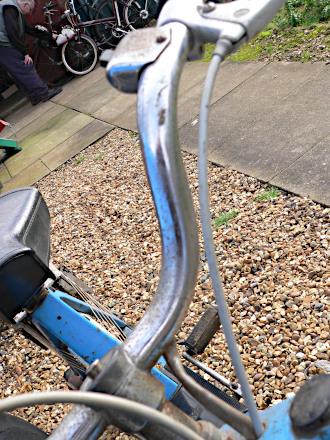
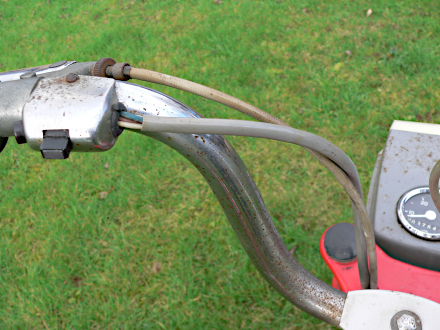
An interesting feature of note is that the wiring for the beam–dip–horn switch is threaded through the inside of the stem-mounted left-hand handlebar, while the headlamp off–on main switch is trickily hidden underneath the shell, and no speedometer is mounted in the top.
Given weight is 92.6lb, though we decide to check, and slide the bike across the bathroom scales to weigh 3 stone front & 4 stone rear = 98lb, but there’s fuel in the tank, so that’s near enough for us.
Turn on the fuel tap, push in the choke rod on the carb nearside, which will release when the throttle is opened. Using the decompressor lever beneath the twist-grip to get the motor spinning easily; simply pedal off, drop the trigger and the motor readily starts. With the bike constructed to a 40km/h specification and rated at a lowly 1.5bhp, we have a low expectation of performance, but it proves weaker than expected, going up an incline is an interminable process between 15 & 17mph, while best downhill paced 20–21mph. Enough to say that the brakes were never challenged.
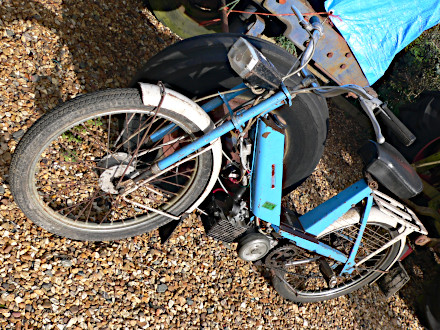
Following this obviously below par effort, the engine and exhaust system were thoroughly de-coked, decompressor valve reground, carb needle moved down into the top notch to weaken the mixture since it was four-stroking on the first run, and air filter foam replaced with a lighter grade.
Following this attention our typ-28 delivered performance more comparable with its 40km/h rating: around 23–24mph on a downhill run.
The 28 had only in been in production for a couple of years before Považské Strojárne began to appreciate that sales were proving disappointing, so replaced it with the small-wheeled version instead, and by this time a change in the Netherlands’ regulations was now accepting smaller wheels.
The 16" wheeled Model 206 with its same rigid frame and all other features, began deliveries from the factory in 1973 to customers in Germany, USA, and the Netherlands. It was still a pedal start, single-speed moped with a centrifugal clutch, but this time its simplicity was readily adopted by the markets.
From a total annual production of 60,000 units in 1974, the Model 206 sold 18,000 units into Germany alone, and even received a Federal design prize. The Babetta was finally making its mark.
The 206 was also sold into the UK and listed as Babetta MkIII during 1974 and up to June 1975 when imports stopped.
In 1975, PS re-designed the rear part of the moped, giving it rear suspension units, introducing this as the Babetta type 207, which became so successful that in 1976 the entire production was exported. West Germany alone took some 20,000 mopeds, selling them through the catalogue firm Quelle.
Imports to the UK resumed again in January 1977, and now it was the turn of the Model 207.
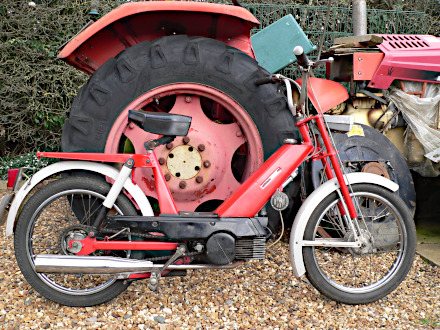
The frame plate on our orange Model 207 shows it was made in 1977, but not ‘T’-registered until 1978, and again supplied by Mick Berrill Motorcycles of Henry Street, Northampton. The motor specification was given as the same 39mm bore × 41mm stroke for 48.98cc, but with a redesigned top-end for a higher 7.5:1 compression ratio, 9mm Jikov 2909 carburettor, and now rated as 2bhp @ 4,500rpm.
The frame plate on our orange Model 207 shows it was made in 1977,
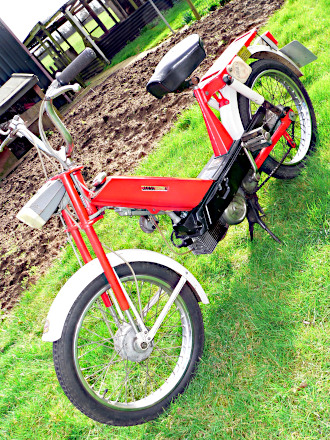
It wears the same ‘Jawa Transistor 40’ decals as our first machine, and also displays no Babetta decals, and neither do period leaflets indicate that any Babetta decals were employed. The frame is constructed with the same tubular steel spine section as the Model 28, but now welded to a different fabricated section to mount a swing-arm with twin-shock rear suspension units and telescopic forks. It carries the same 3.5 litre fuel tank, and gives the same weight of 92.6lbs. There’s the same lighting off–on switch beneath the headlamp, but this time the wiring to the left-hand beam–dip–horn switch is freely hanging on a route outside the handlebar, instead of neatly threaded up the inside of the tube as per the Model 28.
The starting procedure is exactly the same as before: turn on the fuel tap, push in the choke rod on the carb nearside, which will release when the throttle is opened. Using the decompressor lever beneath the twist-grip to get the motor spinning easily, simply pedal off, drop the trigger and the motor readily starts. Despite the 15% increase in compression ratio and 2bhp power rating, the Model 207 is still fitted with the same tiny 9mm carburettor and constructed to comply the same 40km/h Euro market specification, so we’re not really expecting to see any significant increase in general performance, maybe slightly better acceleration and hill climbing abilities, but we’re not going to be holding our breath.
Pull-off ability seems slightly improved, speed paced uphill was around 21–22mph, with downhill pace 23–24mph, while the speedometer was wavering up to an indicated 25mph. The brakes still weren’t challenged, and both models pretty much delivered their performance as expected, but demonstrated there’s a lot of difference between Euro-market 40km/h and UK-market 30mph! Being 5mph short on the top speed, Euro specification machines usually prove unable to keep up with UK traffic pace, and often feel lacking … and if 40km/h seems slow, then these were actually the fast versions!
For Germany and the Netherlands special 25km/h (15.5mph) maximum speed versions were produced, and a 30km/h (18.6mph) version for the US. There, a two-seater version and a ‘Sports’ model were also released.
For 1978 in the UK, the 207 seemed to be presented with a name change from ‘Babetta’ to ‘Jawa Moped’, even though it didn’t seem to have been known as Babetta in the first place!
For March 1979, the name and tank badges again changed from ‘Jawa Moped’ to ‘FreeWheeler’ until this sticker re-branding was discontinued in February 1982, to be replaced in March 1982 by the model renamed yet again as Jawa X30 Nippy and accompanied by a new Jawa X30 de Luxe (which seemed to be the same model at the same price?)
By August 1983 the new 210, two-speed models were being introduced and ran in parallel with the X30 single speed models, until they ended in March 1985.
The 210 models came with a 9:1 compression ratio and general change to a 12mm carburettor for some improved performance in markets that wanted that, though restricted versions with the smaller 9mm carburettor were still available to countries needing lower performance.