
At the end of 1948, the former Simson Suhl factory received an instruction from the Soviet Military Administration (SMAD), that it was to start building a motor cycle with a 250cc four-stroke engine—because directives were how communism ran business after World War II. Production of the machine, called the AWO 425, began early in 1950 and it very much resembled the BMW R25. The manufacture of bicycles, prams, and sporting guns was also re-started but motor cycles were the mainstay of production.
1955 was the year that the Simson name was returned to a vehicle since it had disappeared in 1936 under the Nazis; after over 100 years of existence the Simson brand produced its first two-stroke SR1 moped. At the same time, the AWO 425 became the Simson 425.
The SR1 was a long-stroke design of 38mm bore × 42mm stroke for 47.6cc, with 6:1 compression and rated at 1.5bhp@3,500rpm. It featured simple leading-link suspension in the spindly front fork, with a skinny pivoting rear frame acting on a rubber compression bush behind the saddle tube, and basic mudguards. The general appearance of the SR1 was quite similar to western mopeds of the time.
The manufacturer of these first Simson East German mopeds was actually VEB Rheinmetall-Büromaschinenwerk of Sömmerda in Thuringia. The engines are even identified by the Rheinmetall logo cast on the mag cover and BWS Sömmerda cast onto the gearbox part of the crankcase. Before World War II, this factory had belonged to the Rheinmetall–Borsig conglomerate of Düsseldorf, Berlin, & Sömmerda, which in addition to office machines, also produced various armaments in the final years before World War II. From 1937 onward, Rheinmetall became the second largest German armaments company. In 1938, the company moved its headquarters from Düsseldorf to Berlin but, by the end of the war, most of the Rheinmetall–Borsig plants had been destroyed. With the occupation of Germany, the plants in Düsseldorf, West Berlin and Unterlüß came in the area controlled of the Western Allies, while other Rheinmetall properties were in the territories occupied by the Soviet Army. So it ended up with there being two separate Rheinmetall companies, one on each side of the ‘Iron Curtain’.
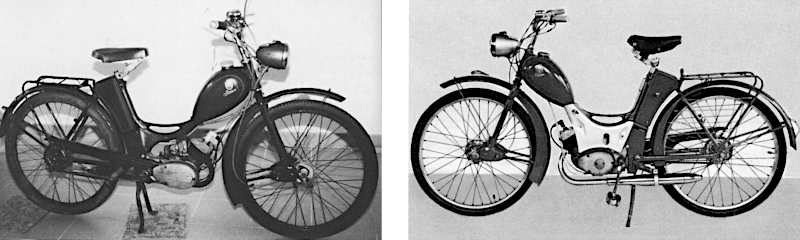
Original (left) and revised (right) versions of the SR1
A slightly revised 1956 SR1 featured additional (though minimalist) front and rear mudguard valances, and pressed aluminium carburettor & frame covers.
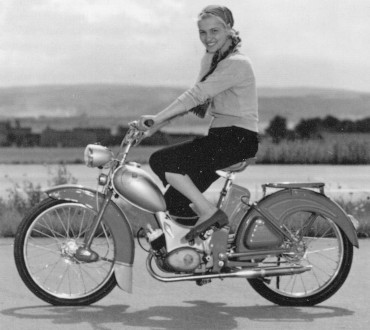
Simson SR2
The SR1 was superseded by the SR2 in 1957, now with extensive front & rear mudguard valances, a new rear carrier, sprung rear ‘monoshock’ frame, improved springing in the front fork, pressed aluminium fork suspension covers, and a cast aluminium stand replacing the former tubular fabricated stand. Engine technical data for the SR2 indicated a compression ratio increase to 7:1, but modestly reflected no increase in the 1.5bhp power rating at 3,500rpm, and a top speed given as 45km/h (28mph).
With the ramp-up of moped production, bicycle production was discontinued in 1957.
The SR2 changes resulted in a significantly improved moped, and it was followed by the SR2E, which went into series production in 1960 and generally replaced the SR2.
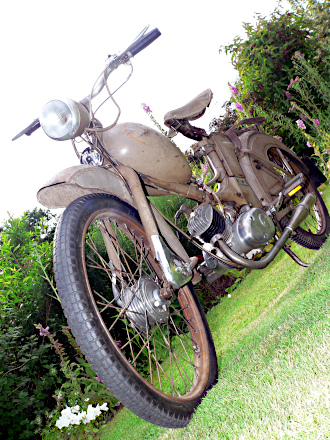
The SR2E was a development of the SR2, created in response to pressure from importers for performance and chassis improvements. The ‘E’ in the model title stood for Exportvariente (export model), and thanks to the intensive efforts of the Suhl factory management, the moped’s further developments were accepted by the East German leadership in Berlin, allowing it to be sold in the GDR home market as well. The development of the SR2 to make the SR2E wasn't particularly extensive, being primarily improvements to the suspension. A new short swing-arm with a central coil spring was installed as rear suspension, while coil springs at the front wheel now increased suspension travel from 45mm to 60mm. The front swing-arm now ran around the outside of the mudguard.
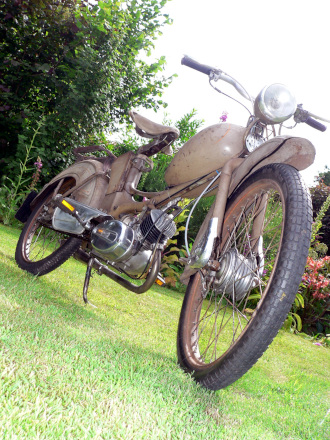
Our SR2E’s frame serial plate indicates a 1960 dating and weight of 145kg. The engine number shows 727285 so it looks to us like this motor is still in first iteration rated at 1.5bhp, probably with a 7:1 compression ratio. Conflicting engine technical data for the SR2E indicated a further compression increase to 7.5:1 ratio, increasing power to 1.8bhp re-rated at 4,000rpm, but only effective from engine number 850000, so this data looks as if it relates to a later change.
The engine arrangement is unusual, with all the shafts (crankshaft, clutch shaft, gear shaft and pedal shaft) being laid out in a horizontal line, so the crankcase appears somewhat longer than more typical compact moped motors. It’s also different in that the gearbox and clutch operation is located in a compartment underneath the engine, so the control cables enter at the bottom front of the motor.
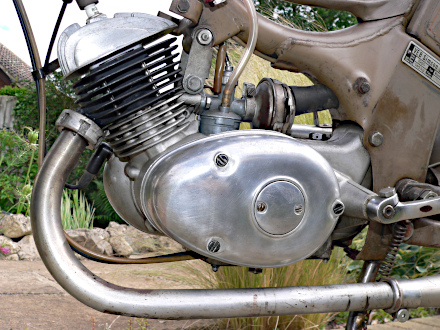
It has an alloy cylinder head and a cast iron cylinder with seven fins on the block; this is only 50mm deep, so the 42mm long-stroke crank withdraws the piston almost completely into the case at bottom dead centre. Consequently, an extended cylinder liner projects deep into the motor, which is matched up to the barrel with a further five fins continuing down the aluminium crankcase. The carburettor bolts onto and feeds directly into the back of the crankcase where the inlet still operates by conventional piston porting. It’s certainly an original and interesting moped engine by Rheinmetall.
The 90mm Remak cast alloy hubs with chrome plated spokes look pretty good quality for 1960. The steel rims are painted in the same beige colour as the frame, with matching orange coach-lining, and tyres are sized 2.25×19.
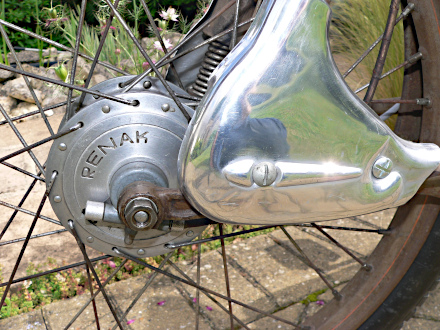
The aluminium fork covers are complemented by a large aluminium chain guard shielding the main drive chain on the right-hand side, which is somewhat unusual (main drives are more commonly on the left), and the brake plate with back-pedal rod linkage is also on the right.
Throttle & gear-change castings and brake levers look similar to period West German Magura controls, but are obviously not Magura since they are unbranded. The rear lamp unit in a pressed aluminium shell is also similar to period West German products, but unbranded, and again just a little different.
Further looking at what would be proprietary components on a typical western moped, the 13mm carburettor is marked ‘BVF’ on the float bowl, there’s an ‘MW’ logo on the speedometer, unrecognisable symbols and mysterious squiggles on the headlamp and tail-light lenses, and ‘W’ & ‘Made in Germany’ (though in English) cast on the fuel tap body! All these logos and symbols probably meant something to some people in East Germany some 70 years ago, but now? What do these hieroglyphs tell us today?
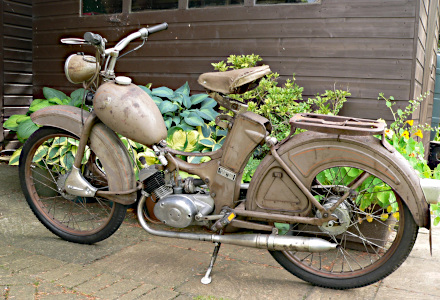
The fuel tap switches off–on–reserve. There’s a flood button on the right-hand side of the float chamber and a strangler on the air intake—switch up for strangle and down for clean air—though the strangler setting seems to have little effect in either position. The flood button sometimes seems to help to get it firing by the pedals when spinning the engine over in neutral, though at other times it just seems easier to push it down the drive in gear, from which it more readily seems to respond. Once fired up, the engine runs quite happily almost immediately, as if to say ‘what’s the problem?’ The motor pulls easily away in first as the clutch is released, and while gear selection seems to locate first easily enough, switching up to second requires a bit of annoying ‘feeling around’ to find the engagement position. It seems there should be a positive stop on the up-shift to aid easier gear location, perhaps something wants improvising to block the over-shift, it could make life so much easier. Finally fumbling into second finds you can easily crawl along at practically tickover, then just open the throttle and the motor torque pulls confidently up and away without any need to pedal assist. The motor cruises comfortably around a paced 25mph, though can also easily run along at town traffic pace, however the revving noise and vibration does become somewhat distracting on the 33mph sat-nav paced light downhill run.
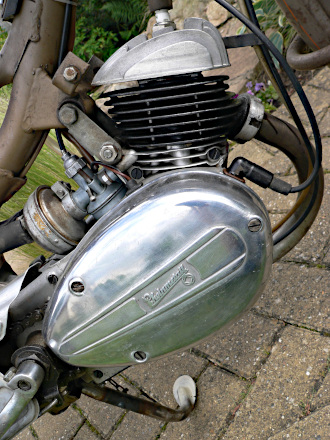
On returning to base, it seems somewhat noisier than when we set out—the exhaust gland nut had come loose!
The Rheinmetall engine feels impressively strong considering its age and seemingly low 1.5bhp power rating, and certainly felt under-geared. It should easily pull a higher final drive ratio, for a higher cruising speed, which would probably reduce vibration.
While the speedo doesn’t appear to work in the normal sense, the needle does bounce occasionally, promising some forlorn hope that it might just spring into life again anytime…
Considering that SR2 was apparently rated at 45km/h (28mph), we thought our SR2E gave a pretty good performance account of itself for an obviously well-used, 66-year-old machine … that was impressive! The later higher power rated versions must be really good for their time.
The brakes seemed incidental, since both worked adequately enough. The rod-operated back-pedal rear brake could be applied with as much pressure as needed to achieve the required stopping result; even stand on the back pedal if you want!
The suspension proved better than expected with a fair ability to soak up a degree of rough road conditions.
The lights worked, though somewhat dimly. Both the horn and ignition cut-out failed to function, so when we get back to base with the engine ticking over like a wristwatch, the only way to stop it is to turn off the fuel and wait, or stall the motor in gear. December 1960 introduced a new round speedometer in a new headlamp shell.
As the Cold War boiled toward its climax, more and more refugees fled from the GDR to the west. Accordingly, the ‘Zonal Border’ was sealed off, and on 13 August 1961 the GDR government ended free access to West Berlin. The communist authorities built a wall through the city, and along the borders, with the Federal Republic becoming a deadly no-man's-land of mines and barbed wire, guarded by machine gun nests in watchtowers.
During the next 28 years many people would lose their lives attempting to cross it.
The Suhl factory had produced some 209,000 four-stroke motor cycles from 1949 until they were discontinued at the end of 1961, as directed by a new decision from the authorities to have motor cycle production in the GDR exclusively carried out by MZ from 1962 onwards.
Only the production of mopeds, mokicks, and kleinstroller (scooterettes) would now remain with Simson. This division of market segments would remain in place until the end of the GDR.
On 13 September 1962, the one-millionth small motor cycle was recorded leaving the Simson production lines.
More revisions were made to the SR2E moped in 1962, but did not affect the model designation. The front swing-arm was redesigned again, and the suspension travel further increased to 72mm. The front fork was now welded and more robust. The saddle suspension was also improved. From engine number 850000, engine power was increased to 1.8bhp by raising the compression ratio to 7.5:1 and modification to the port timing in the cylinder, which primarily improved acceleration. Other improvements included the kickstand, luggage rack, and other features. A little later, more minor changes were made, including reinforced wheel axles, a new speedometer drive, and a modified tail-light with a significantly larger lens.
As four-stroke motor cycle manufacturing ended in 1962, the Simson factory shifted further towards mopeds, light two-stroke motor cycle and small scooter production, at which point more aspects of moped production were moved to the Suhl plant.
The moped engines, however, continued to be manufactured in Sömmerda and delivered to Suhl, so the ‘Rheinmetall’ logo remained on the engine casings for quite a time during the GDR era. Following a legal dispute with the West German Rheinmetall conglomerate, the factory was renamed ‘Supermetall’, then ‘Soemtron’, and became the main plant of the newly founded ‘Robotron’ combine; a ‘Soemtron’ logo replaced the ‘Rheinmetall’ logo on the engine mag cover casting.
In 1963, adoption of the cylinder head from the KR50 resulted in an increase in compression to 8.5:1, and a power boost to 2.0bhp. However, this was only retrospectively acknowledged by the Simson factory, so the official SR2E specifications remained at 1.8bhp.
While the SR2E was a solid and robustly designed moped, customer popularity was drifting towards more motor-cycle-like, two-seater mopeds with footrests, three- & four-speed foot-operated gearboxes, and increased engine power. To address this trend, Simson introduced a new model range in 1964.
The original Rheinmetall 38mm × 42mm, long-stroke, 47.6cc engine design was revised for the new models to slightly over-square dimensions of 40mm bore × 39.5mm stroke, now 49.6cc displacement, and launched the SR 4-1P Spatz moped, SR 4-1K Spatz mokick and SR 4-2 Star 50cc mokick motor cycles, with the SR 4-1P Spatz being considered the direct successor to the SR2E
After 1964, replacement frames for the SR2 were still produced, the type plates of which may indicate a correspondingly later year of manufacture.
By the late 1960s, MZ motor cycles were making inroads into the British market, gradually increasing their share due to the hard work of Sheffield-based MZ concessionaire Wilf Green. In the early 1970s the ES and ETS models were replaced by the TS range, and thanks to a multitude of complimentary motor cycle press reviews and expanding dealer networks with competitive pricing, sales really started to take off.
Simson models were only first listed in the UK from January 1972 as the SL1-S, a single-speed rigid frame moped, and SR4-2/1 Star.
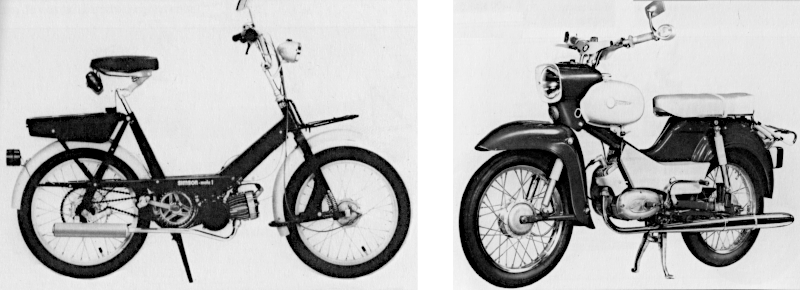
SL1-S and SR4-2/1 Star
After several weeks of civil unrest, the East German government announced on 9 November 1989, that all GDR citizens could now visit the Federal Republic of Germany and West Berlin.
A few metres from the Berlin Wall, the Brandenburg Gate section reopened on 22 December 1989, while crowds of East Germans crossed and climbed onto the wall, joined by West Germans from the other side, and souvenir hunters chipped away parts of the masonry over the following few weeks. Full demolition of the wall began on 13 June 1990 and concluded in 1994. The fall of the Berlin Wall paved the way for German reunification, which formally took place on 3 October 1990.
During the Berlin Wall period, 100,000+ people attempted to flee from East Germany, with over 5,000 succeeding in escaping over the Wall, and an estimated death toll of those killed by East German authorities ranging from 136 to more than 200, in and around Berlin alone.